Consider the humble flash card: a cheap and powerful learning tool that anyone can make. Cut out a piece of paper, write something on each side, and you can use it to memorize and test yourself on any piece of information.

Many of us have probably used flash cards in a school setting, to drill things into our memory while studying for a particular test. But by themselves they do little to develop our long-term memory; throw out the flash cards and those memories will soon wither, unless you keep exercising them regularly in some way.
So what do you do if you want to memorize something and keep that memory with you forever? One way is to make the subject matter a regular part of your daily life. If you're learning a foreign language for instance, you can make a point to read books or watch TV in that language even when you're not around others you can speak it with. But there's an even more direct and reliable method: keep each of your flash cards around and review it at increasingly large intervals to see whether you still remember it. This strategy is known as spaced repetition.
The power of spaced repetition lies in its efficiency: in exchange for spending just 5−10 minutes of your time every day to review some cards, you gain the ability to remember anything you want in as many subjects as you want for as long as you want. Even if, like me, your interest in one of the languages you're studying goes dormant for a while, a simple dedication to reviewing some cards every day ensures that whenever you pick it up again, you'll still have all the vocabulary right there in your head.
The challenges of spaced repetition are usually (1) finding a system that works for you to manage and schedule all your cards and (2) keeping a habit of using it every day. Keeping track of potentially thousands of cards might sound like a needlessly laborious task, which is why many people turn to virtual flash cards, relying on an app like Anki or Mochi to tell them what to study each day.
Here's the thing though: you don't need an app at all. Spaced repetition learning can be fun, hands-on, and incredibly simple. In this guide I introduce Memory Garden, an endless “deck building” game that you can play with paper flash cards to grow your memories, level them up, and use them to explore new lands or unlock new skills.
How to play
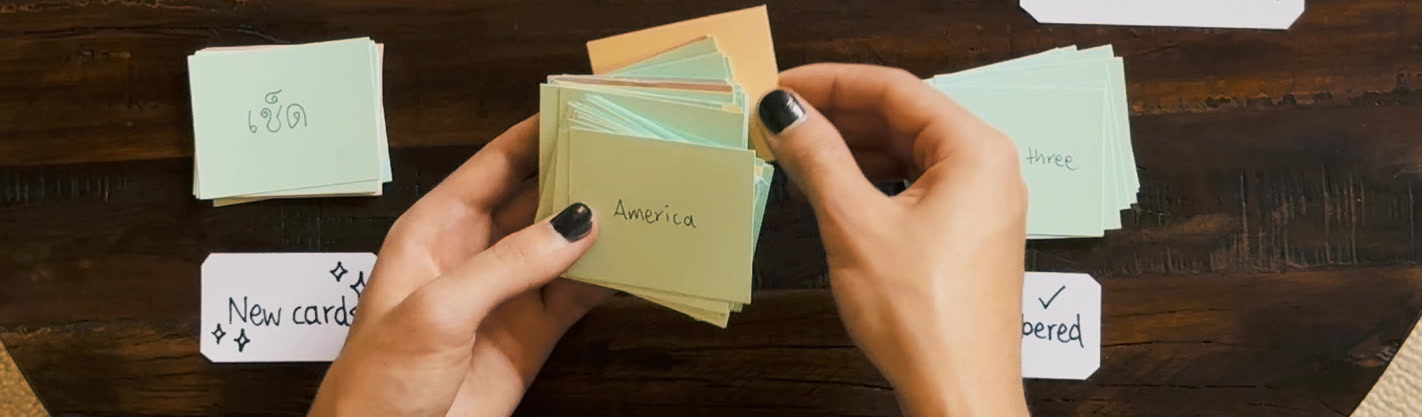
The game works best if you add some cards to your decks nearly every day and review them nearly every day too. Whenever you're going about your day and notice something that you want to memorize, write it down on a flash card and set it aside on your new cards pile for later.
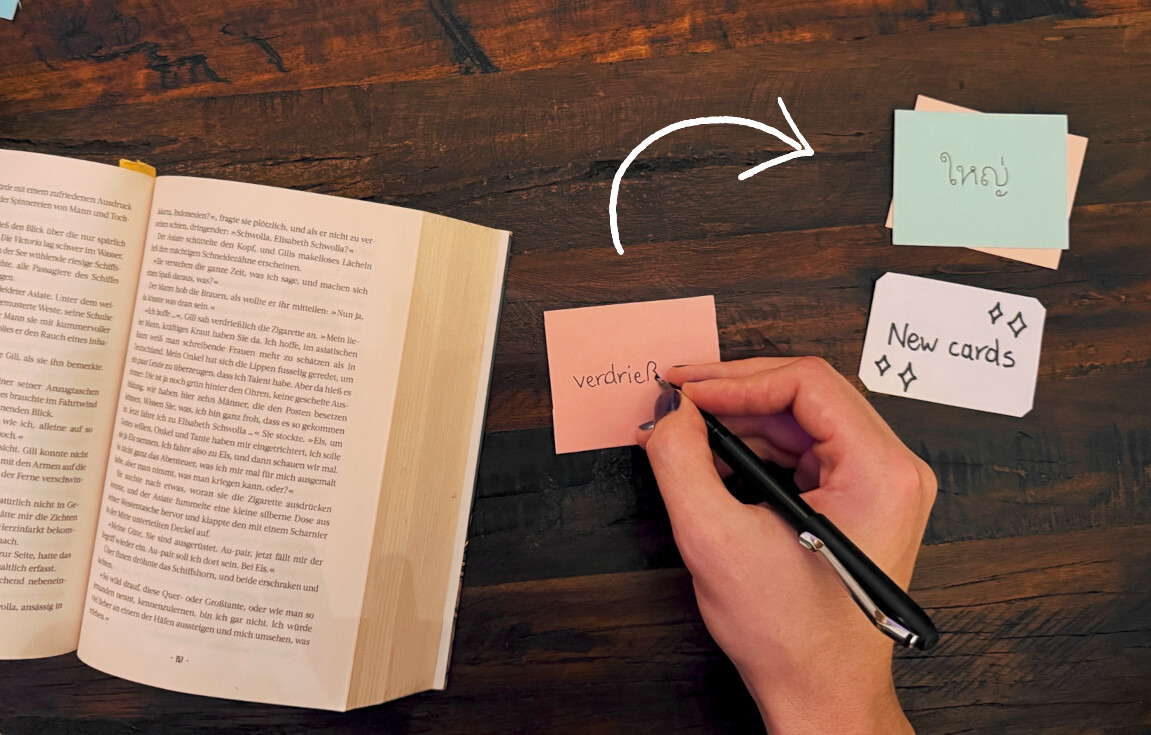
As with any flash card, it has the best chances of growing into a strong, lasting memory if the information is both bite-sized and meaningful to you. You can even try switching up the format, doodling on the card, or leaving some bonus ‘fun facts’ on the back to make it more memorable.
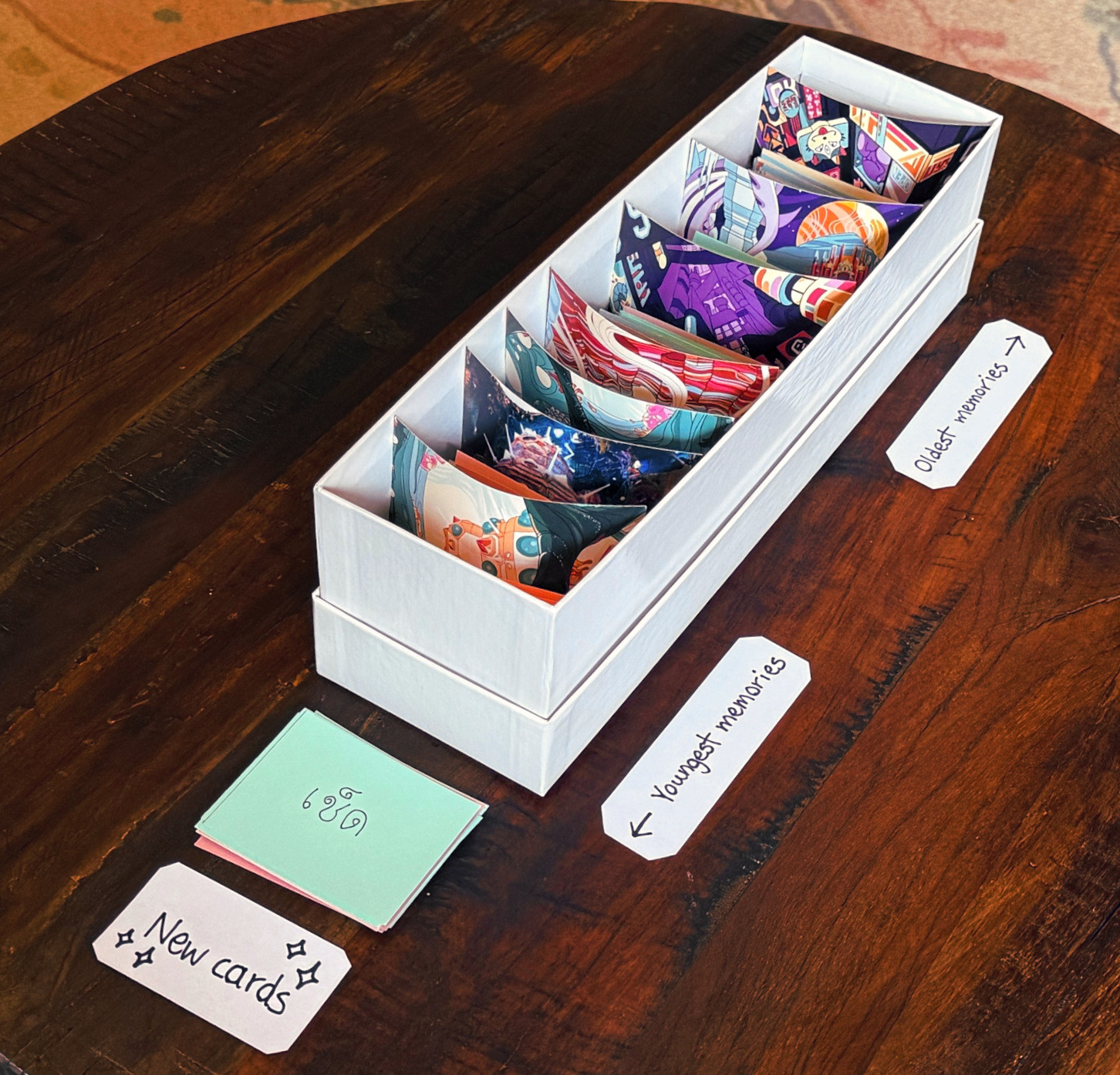
Now for the rest of the setup: you'll keep all of the cards that you've learned before in a series of decks arranged from youngest memories to oldest memories.
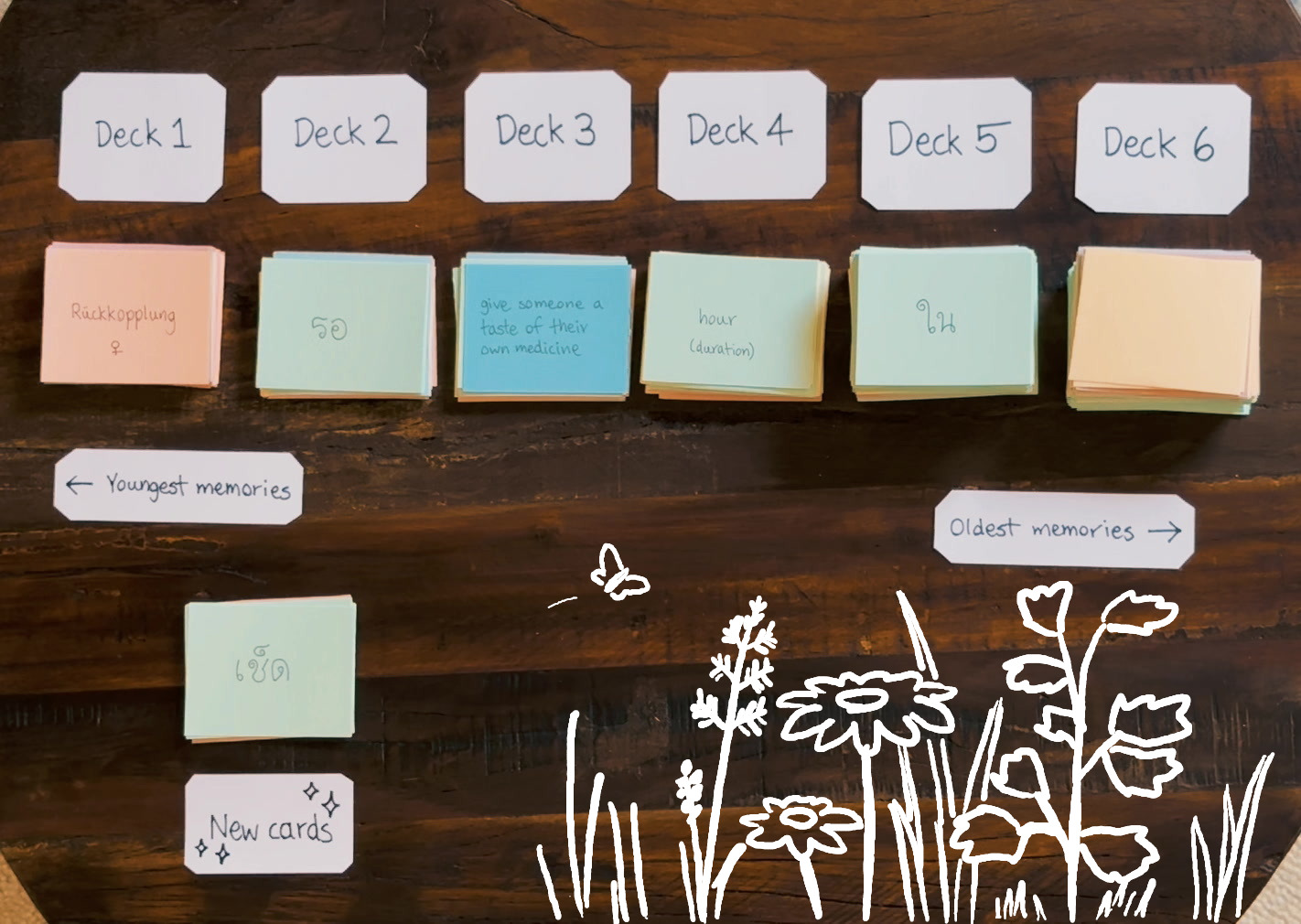
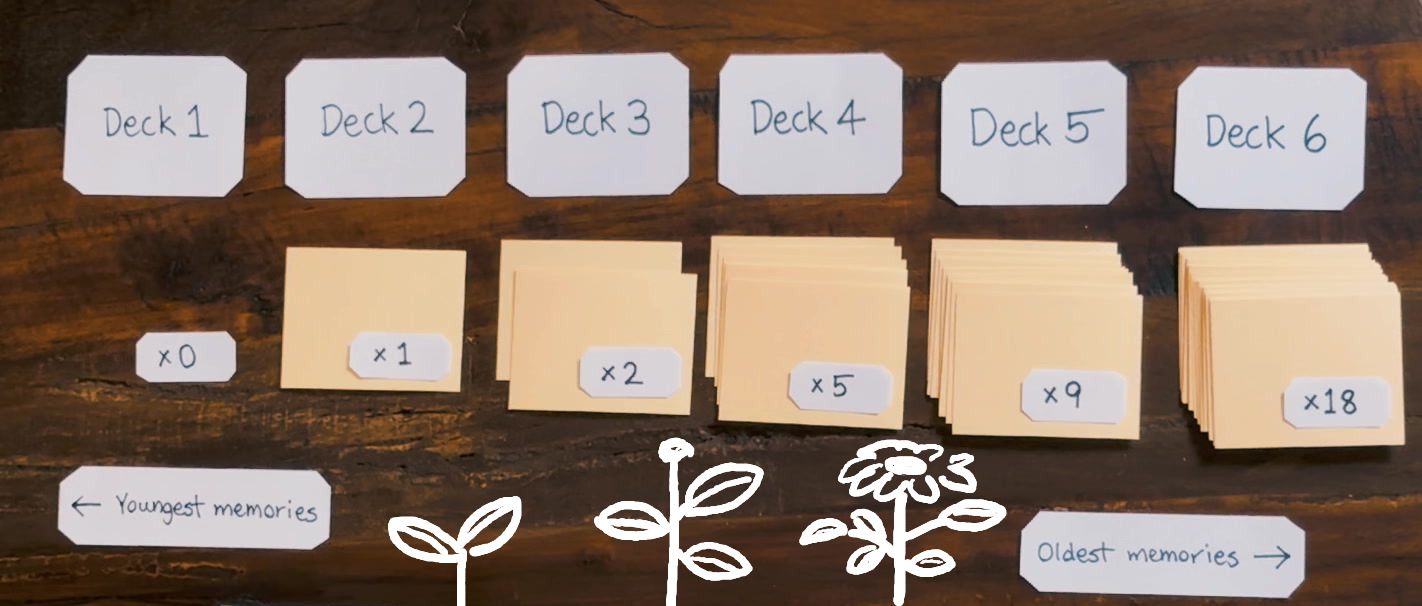
Each deck will always contain a certain number of blank cards mixed among your actual flash cards. This determines the number of days that a card in that deck will take to bubble to the top and require your review. For best results, each deck should have roughly twice as many blank cards as the deck before it.
When it comes time for your daily review, go through the cards at the top of each deck, starting with the oldest memories and working your way down.
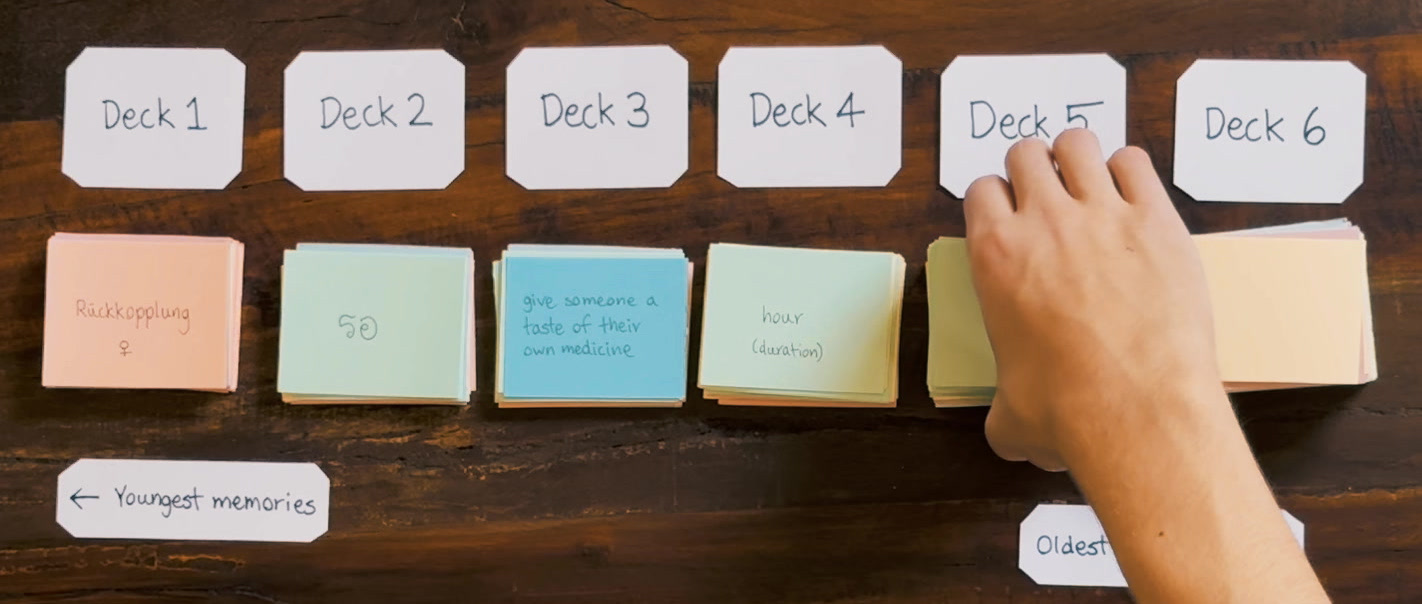
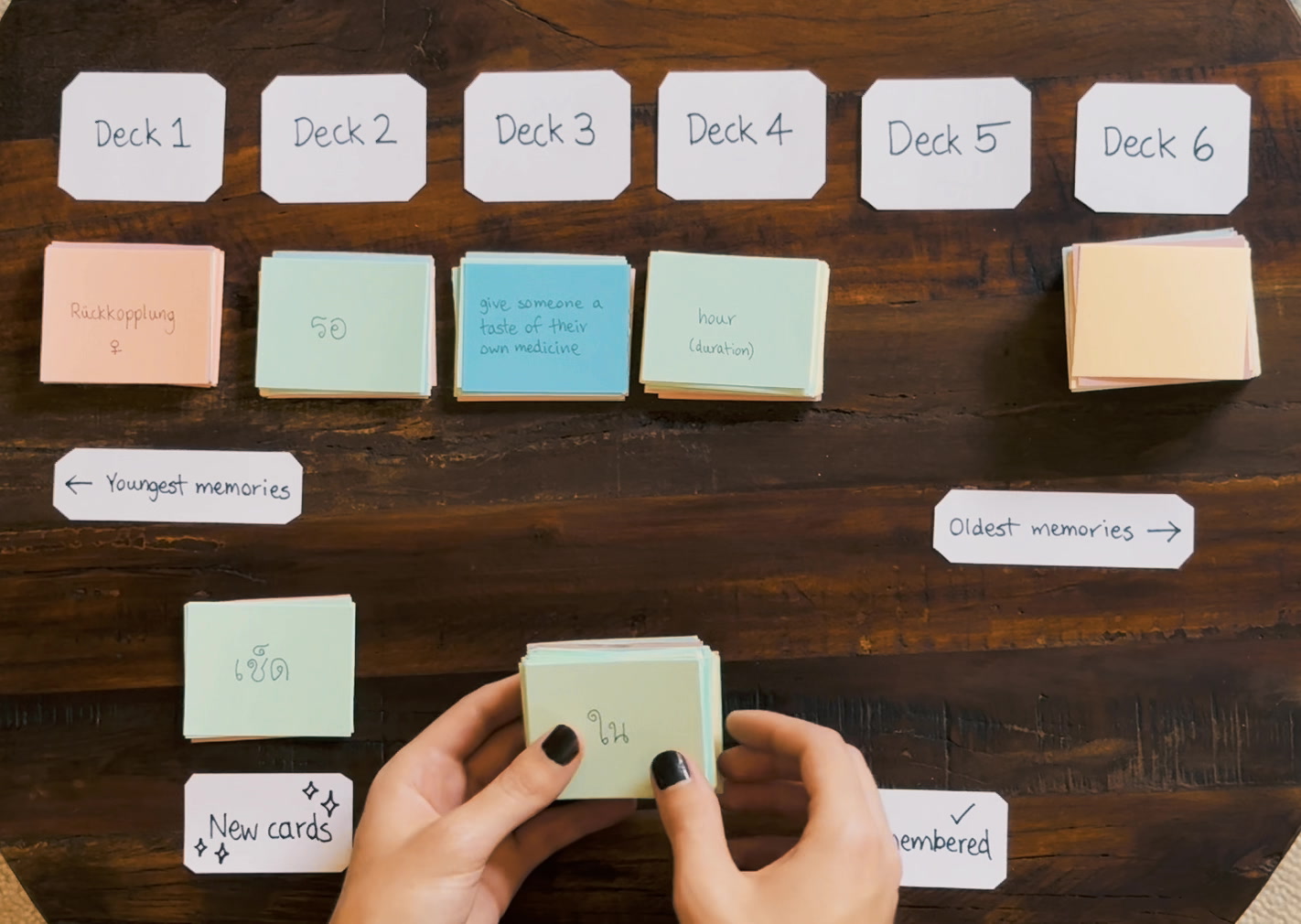
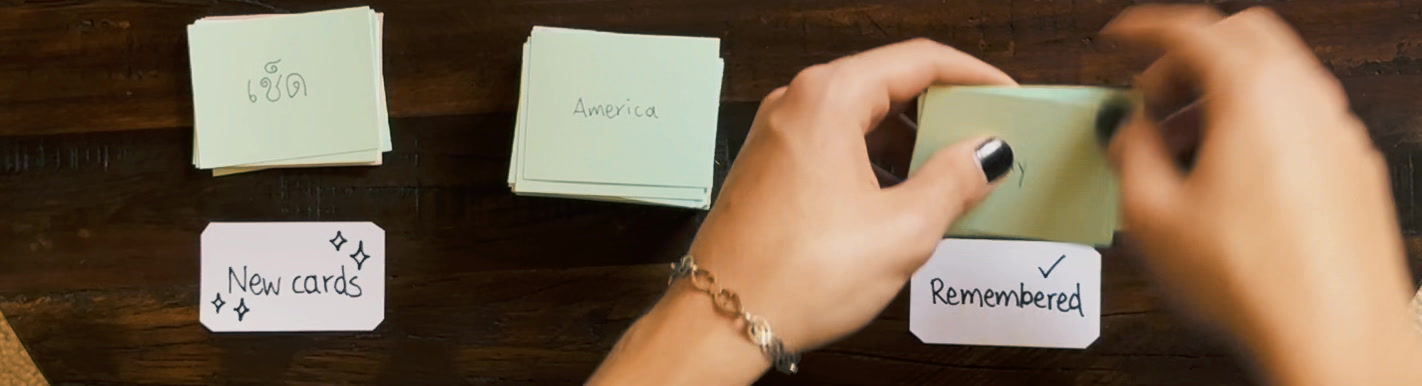
When you remember a card, it “levels up” and is ready to move to the next deck; set it aside in a little pile for now.
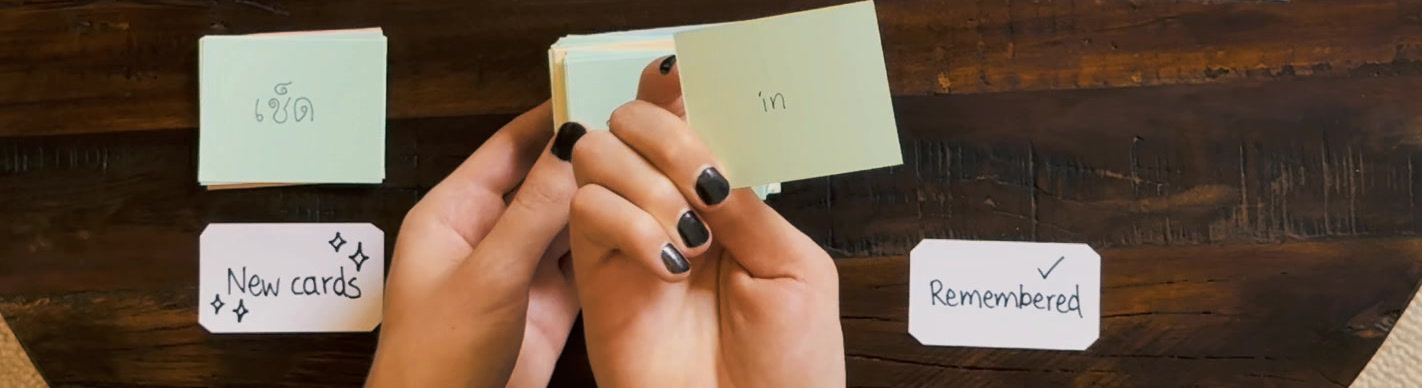
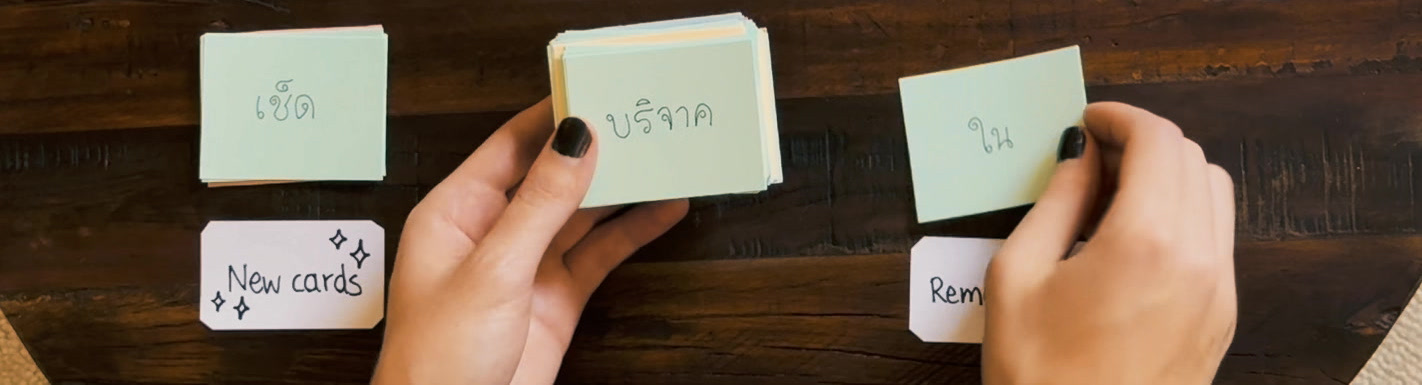
When you forget a card, it needs to be relearned; put it back at the bottom of the new cards pile.


As soon as you reach a blank card, stop. Move the blank card to the bottom of the deck, and sort all the cards that you remembered into the bottom of the next deck.
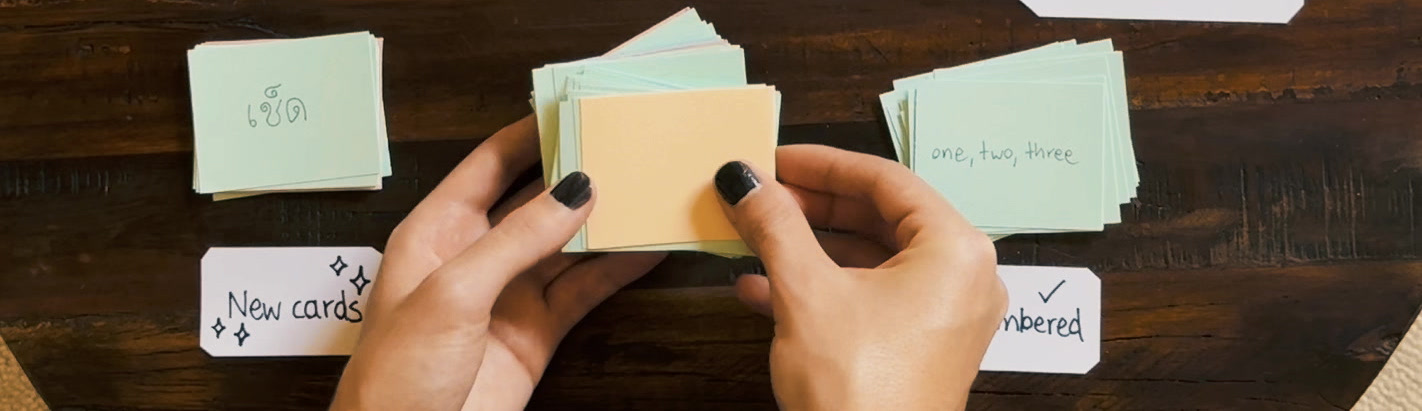
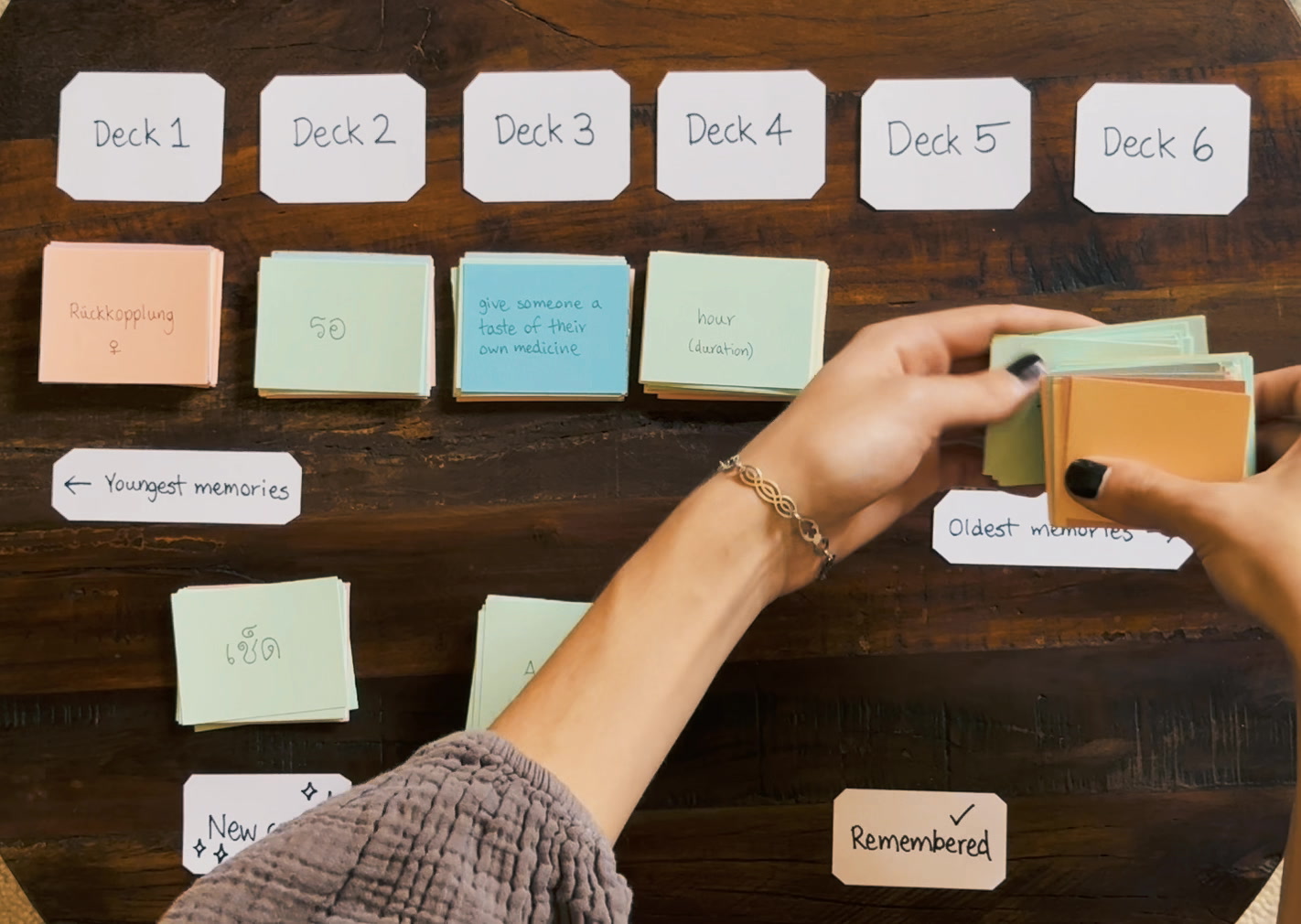
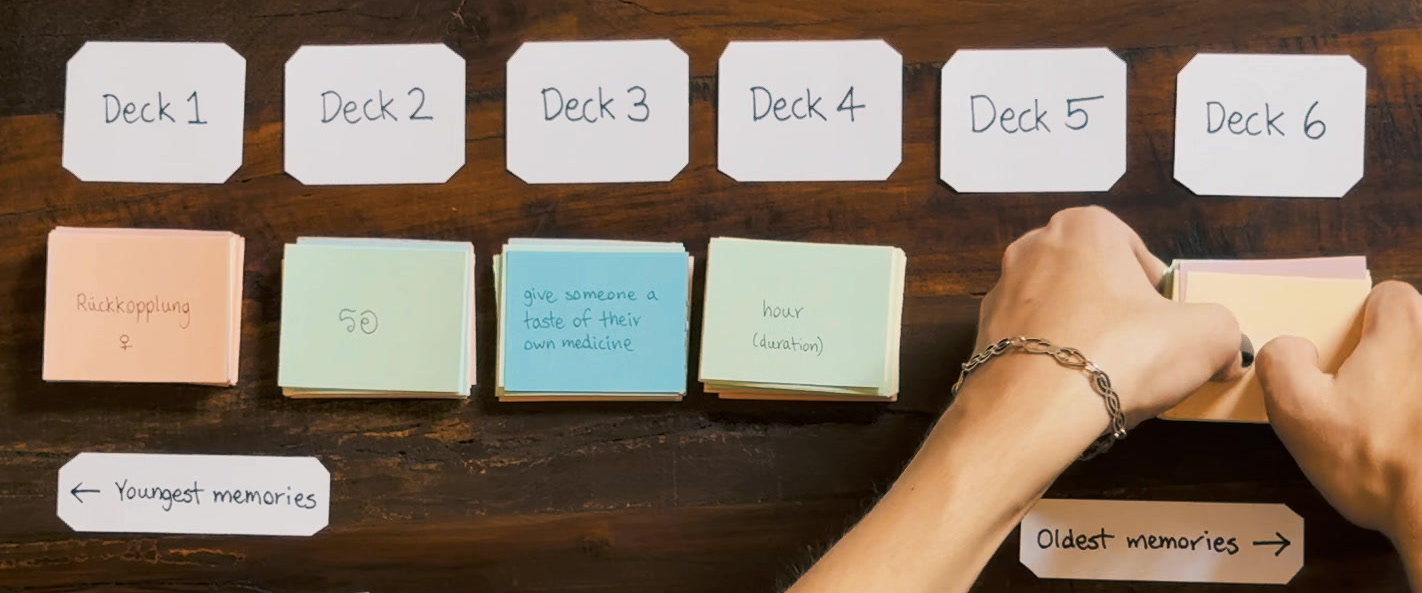
Then repeat this process for each of the remaining decks with younger memories—reviewing until you reach a blank card, promoting the cards that you remember.
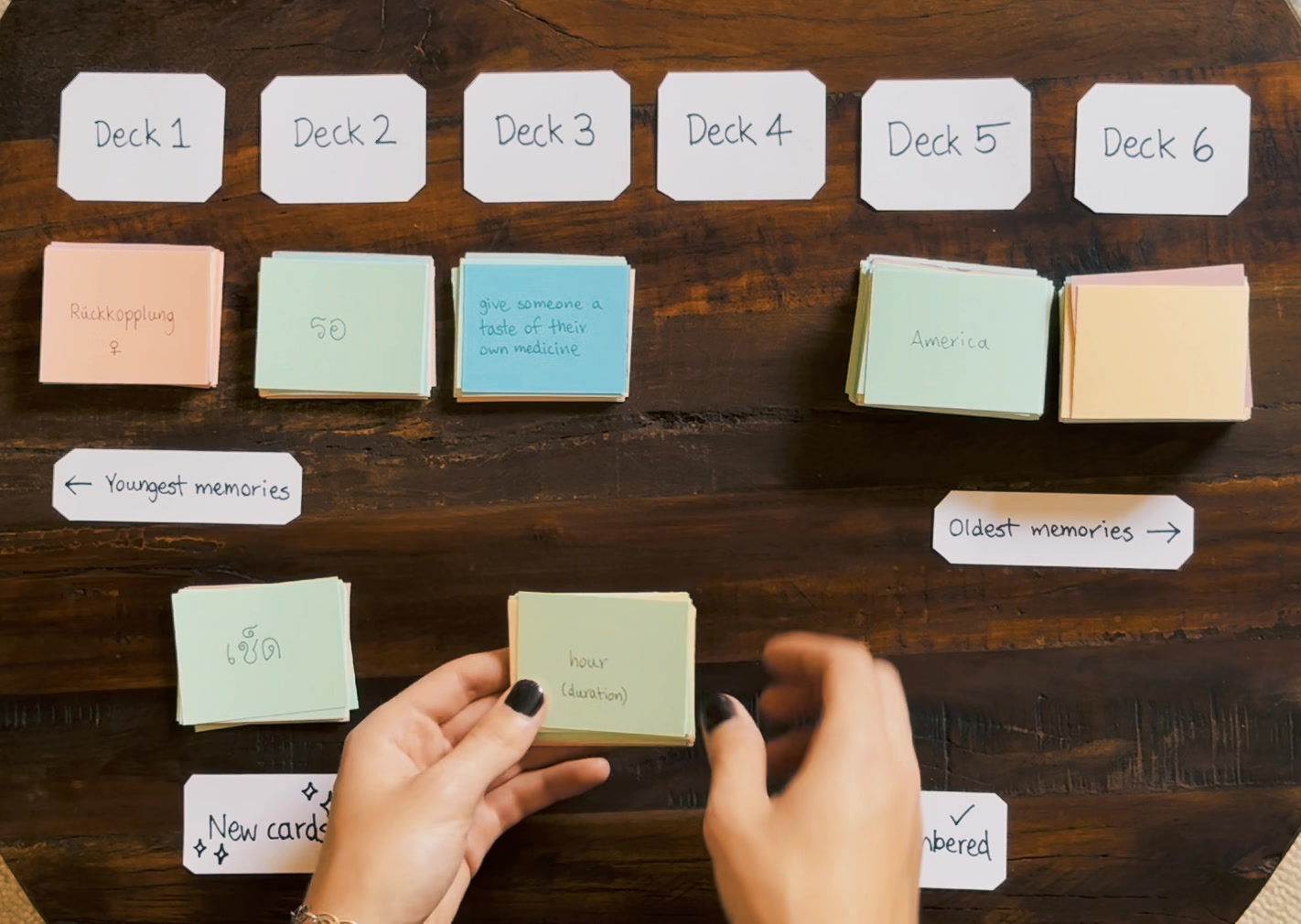


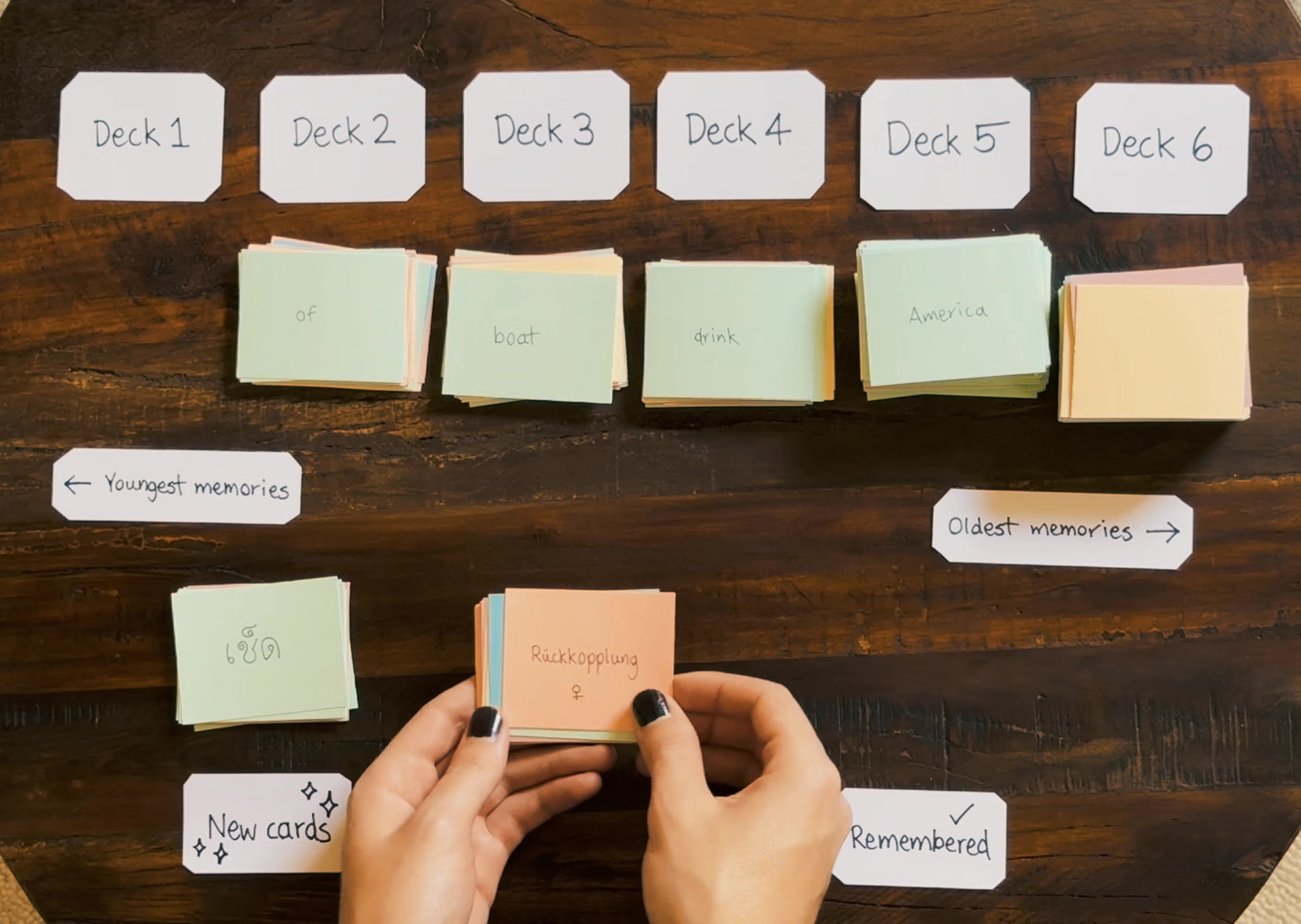
Finally once you've been through all the decks, review everything in the new cards pile.
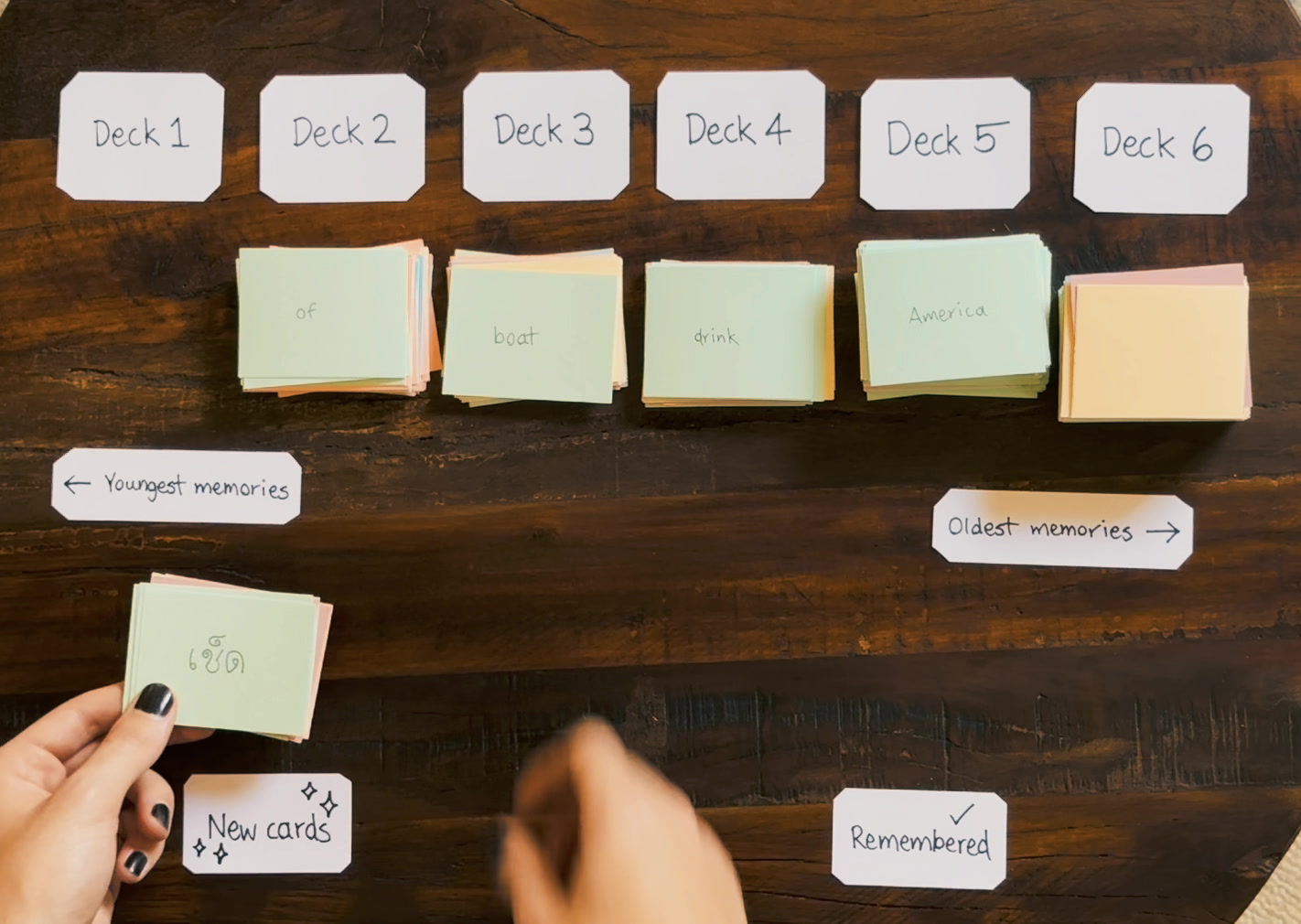
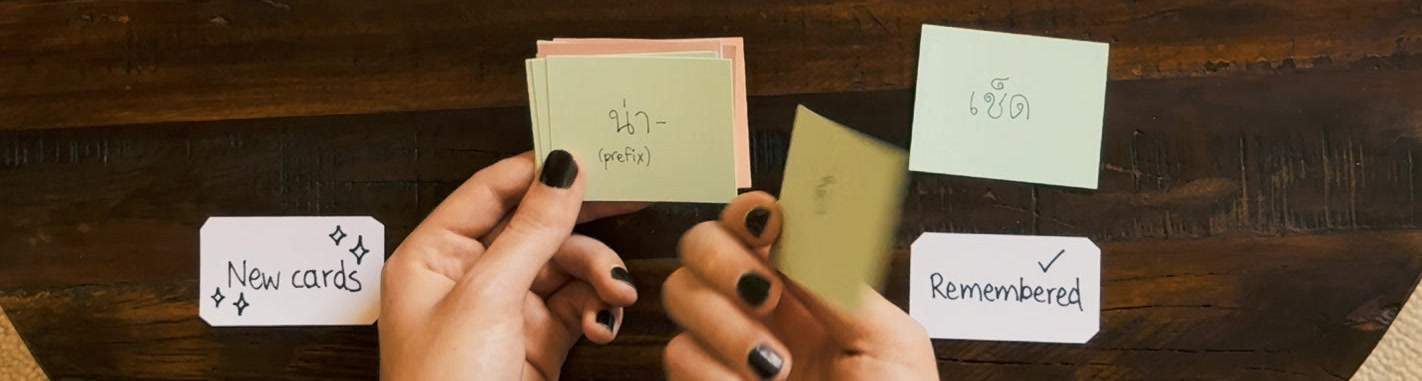
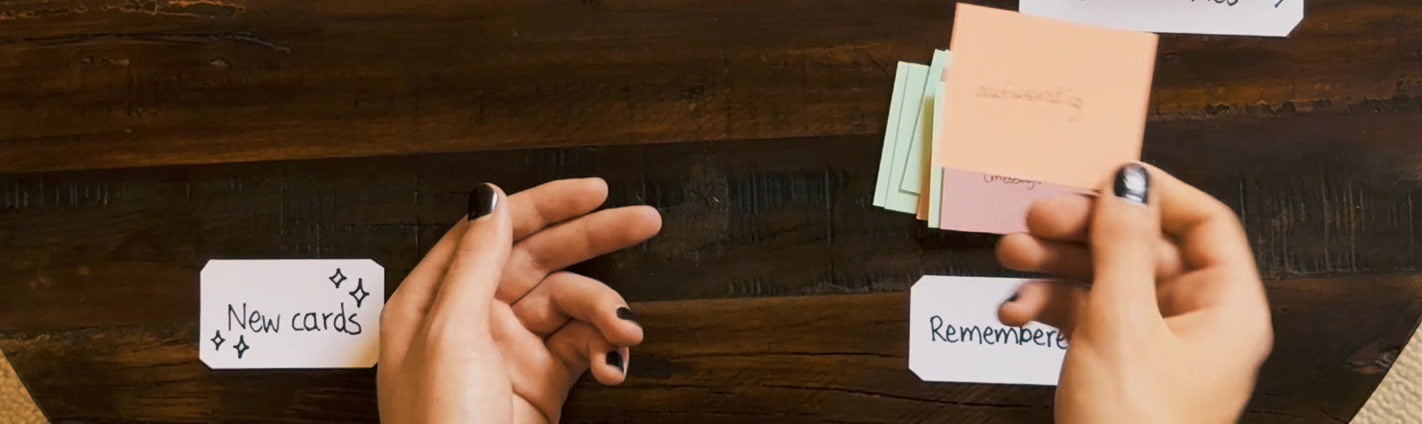
Now that you've committed them to heart, those brand-new memories will go into Deck 1. And congrats, you're done for the day!
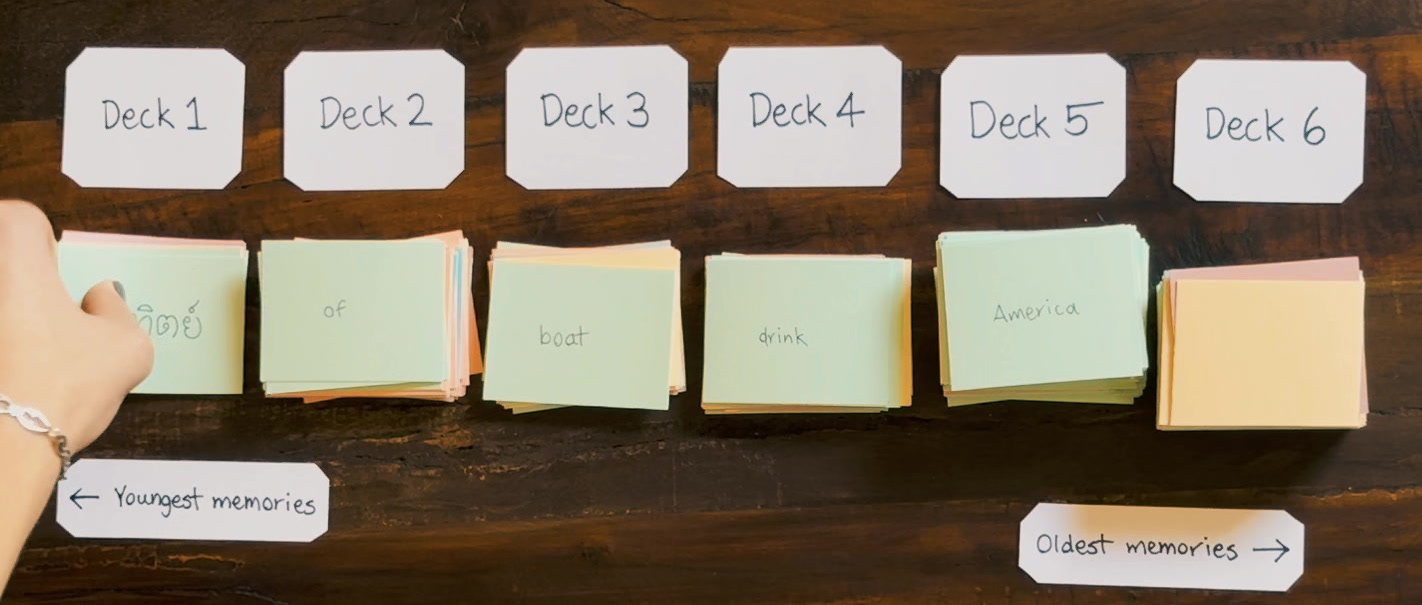
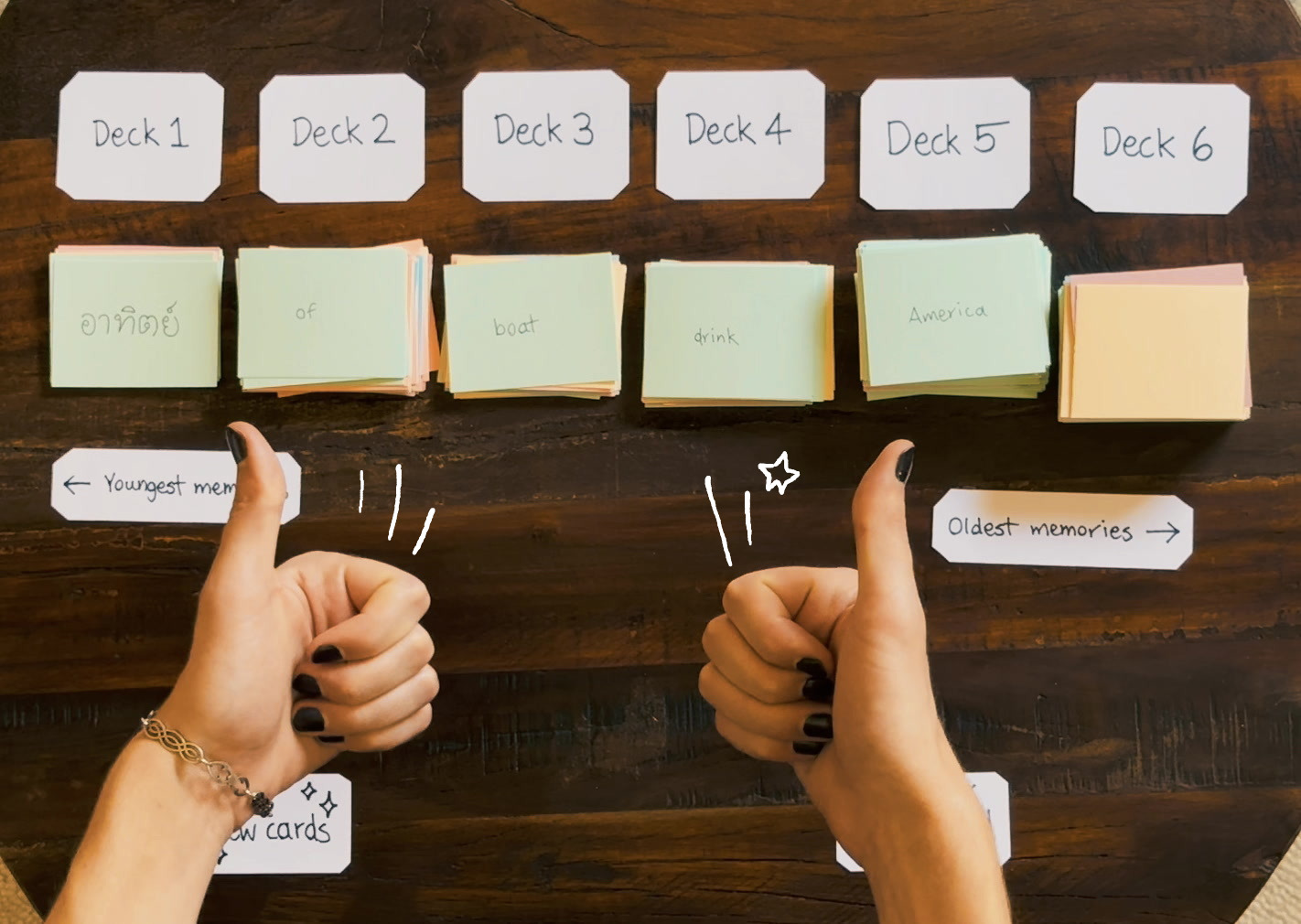
Full video review
If you want to see any of those steps in more detail, you can jump through the following 8 minute video which shows me doing a review of all six decks.
Pro tips
Use as many decks as you want. The more decks that you have, the longer you'll be hanging on to each individual card, and so the more likely you are to remember them for years to come. The demo above shows six decks just because that's what I could fit in the picture, but I recommend keeping at least seven or eight decks worth of cards to see any real benefits to your long-term memory. Once a card leaves the last deck, it can be “retired” permanently to the wastebasket.
Shuffle your cards when you level them up. This is optional, but giving any groups of cards a quick shuffle before putting them in a new deck ensures that you're not going to remember those cards purely because of the particular sequence that they appear in. In the real world, it's more helpful to be able to recall things at random.
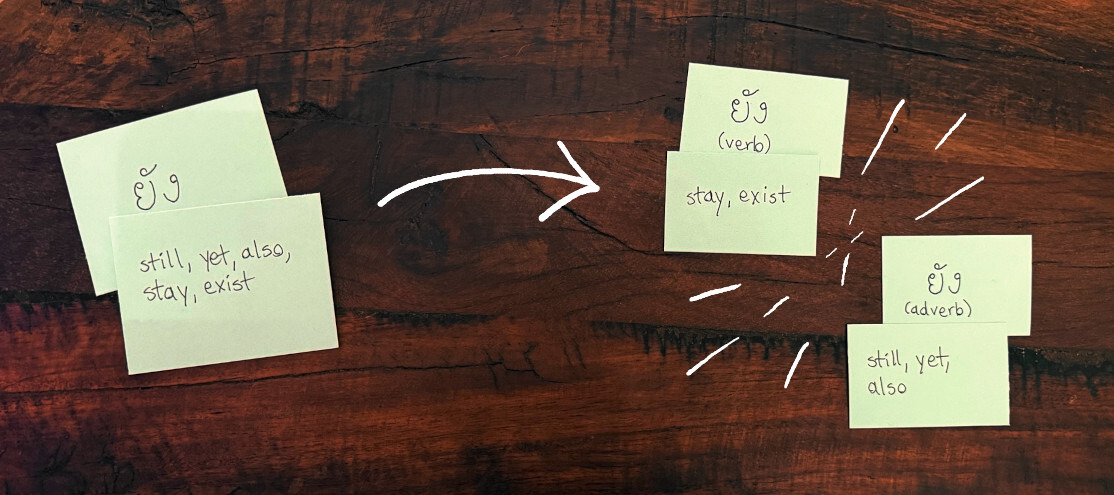
Prune unruly cards. When a card has too much information or the wrong kind of information on it, this can stunt its growth. If you keep having trouble remembering a card, you may want to “prune” it by splitting it up into smaller, more manageable pieces.
Don't sweat it if you skip a day. More important than reviewing your cards literally every day is that you build your reviewing into a sustainable, lasting habit. So even if you skip a few days of reviews, don't feel obligated to “catch up” when you return to your garden by doing extra reviews. Just pick up where you left off, and let the process show you which cards need extra attention.
Keep your garden in a nice box, decorate it, and make it your own. Starting a new habit can be hard, but it gets more enjoyable to tend to your cards if you keep them neatly organized and pleasing to look at. There are many ways to achieve that, but the most hands-on way is to repurpose an old shoebox and dress it up with whatever arts & crafts materials you have on hand. I opted to buy a narrower “wine box” from a paper supplies store for $5 and cut up some cool looking postcards to use as dividers.
Better than Leitner!
At this point, if you already know a bit about spaced repetition, you may be wondering: isn't this basically just the Leitner system?
In short, no, I designed Memory Garden because I wasn't satisfied with the Leitner system. The key difference is that there is no need to follow a complicated 64-day repeating schedule, or to limit yourself to seven decks. Instead, you tend to your garden in exactly the same way every day, and the cards schedule themselves by moving slowly through the decks.
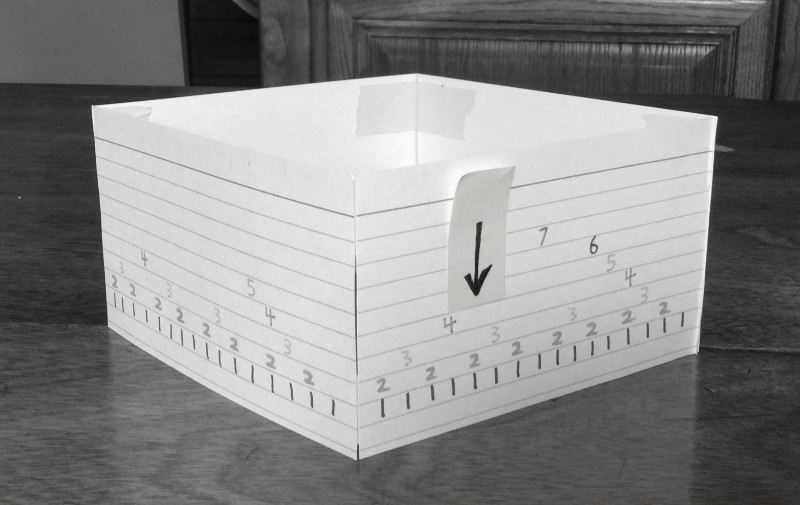
A steady schedule has the further advantage that cards won't “clump up” in large numbers in the higher levels, which would force you to deal with way more reviews on certain days. With this system, you'll see pretty much the same number of cards every day, provided that you don't create too many new cards at a time.
Better than an app?
I believe that in the rush to turn everything into an app, we give up some pretty important things: agency, ownership, and the countless affordances that come for free with physical materials. A flash card program like Anki may be open-source and freely modifiable through community plugins, but even then, the nature of modern software is so complex that adapting it to work in interesting new ways would be prohibitively difficult for most of its target audience. And the cards—which are supposed to serve as the solid, persistent counterpart to the slipperiness of memory—are forever trapped as images behind glass, hidden in ethereal files.
To me, having real flash cards that I can see on my desk, weigh in my hands, scribble annotations on, and stuff in a backpack just feels right. I've only just started my collection this year, but it really feels like something I could keep up with for years to come — it feels personal in a way that Anki never quite did.
And paper flash cards are incredibly flexible too. If you want to adjust the pace at which your cards level up, you don't have to fiddle with opaque numbers in an overgrown settings panel, you just add or remove blank cards. If you find it discouraging to move forgotten cards all the way back to square one, you can just knock them down by a couple levels instead. If you want to break up your review sessions with messages of encouragement or the occasional gamified “action card”, you just shuffle them into your decks. These are things literally anybody can do, because Memory Garden is just an idea.
Of course, there are some capabilities that are currently unique to virtual flash cards, like attaching audio and video samples or locating them with search terms. If you're interested in learning with flash cards, you should obviously use whichever system best suits your needs. But lots of things work perfectly well without any computation, and I think spaced repetition can be one of them.